Canton, MI · Garage Door Service
Installing a new garage door in Canton means matching a cold-severe climate and a housing stock built mostly 1944-1991. Here's what that actually involves.
We don't post a flat number here because installation cost depends on the door itself: steel versus wood-composite, insulated versus not, single versus double, and whether the opener and track need to come out too. What we can tell you is what drives the cost up or down in this area specifically. A lot of Canton garages still have the original opener and track from whenever the house was built, and swapping those out at the same time as the door is usually cheaper than doing it twice. Household income across the service area runs a median of $71,783, and most of the installs we quote land in a range that fits a homeowner budgeting for a planned replacement rather than an emergency. If a job needs a header repair or new jamb wood because the old framing is rotted, that adds a line item we can't quote sight unseen. We'll always give you the number before we touch the door, not after.
The door still opens and closes, mostly. But it's loud, the panels are dented or bowed, cold air pours in around the bottom seal in January, and the opener strains on the last few inches every time. None of that is one broken part - it's a door that's reached the end of its service life. Sometimes it's a homeowner who bought the place and inherited a door from the original build. Sometimes it's damage from a spring or cable failure that took the bottom panel with it. Either way, the question stops being "what part do we fix" and becomes "is this door worth keeping." On a door built for a different climate zone or a different insulation standard than what's practical now, the answer is usually no.
Housing in this part of Canton mostly went up between 1944 and 1991, with the median build year sitting around 1963, and that's true across most of the 33 named communities that make up this service area, where 1960s and 70s construction dominates. Doors installed on houses from that era were built to a much lower insulation standard than what's sold today, and a lot of them are single-layer steel with no thermal break at all. That's a real problem in a cold-severe climate band, which is what Canton sits in. A door that was fine for its first twenty years starts failing at the weatherstrip, warping at the panel seams from repeated freeze-thaw cycling, and losing enough R-value that the garage becomes the coldest room attached to the house. With 121,971 owner-occupied houses across a service area of 225,287 households, this is not a rare situation - it's the standard trajectory for a door that's outlived the build era it came from.
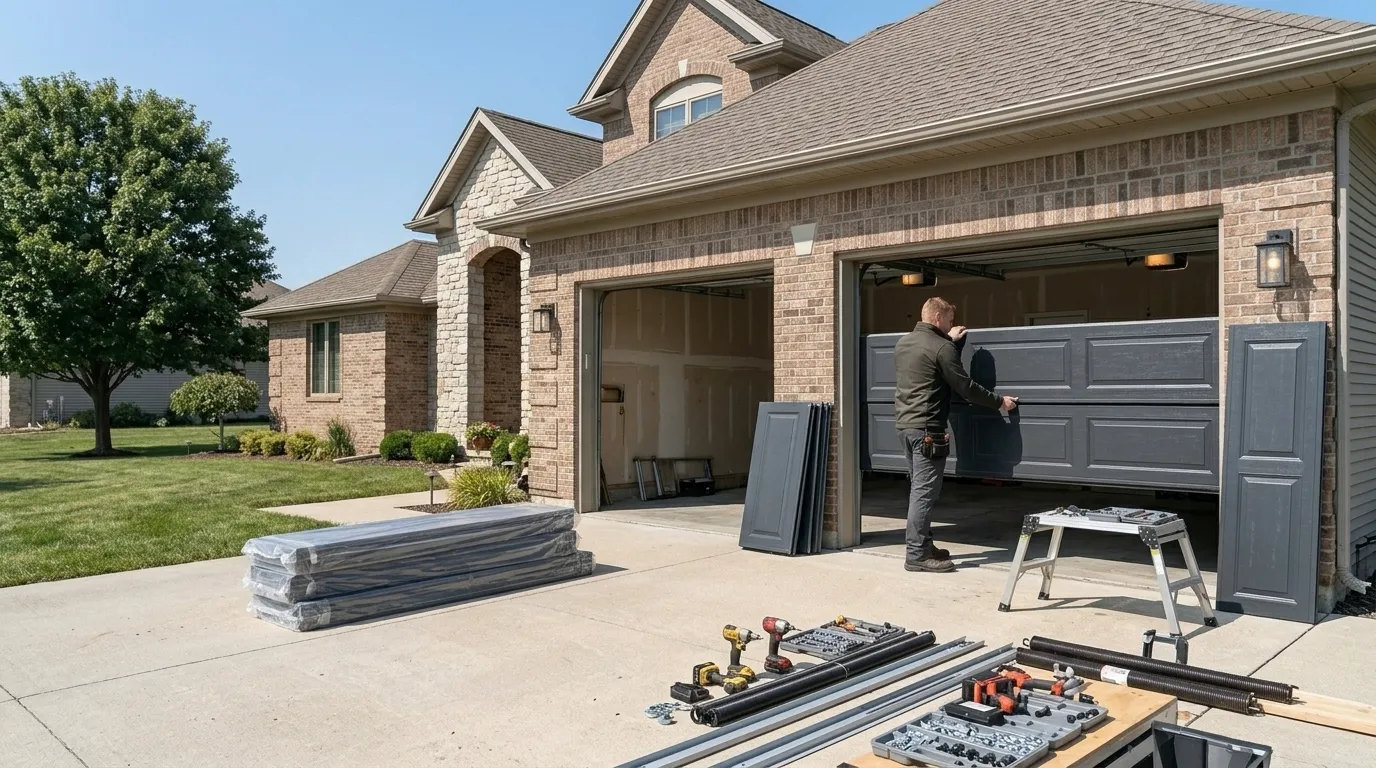
A proper install starts with pulling the old door, track, and usually the springs, since reusing 1960s-era hardware on a new door is a false economy - the drums and cable drag rarely match modern panel weights. We set new vertical track and horizontal track to the header, hang new panels section by section, and set spring tension to the door's actual weight rather than guessing off the old numbers. For a cold-climate install like this, we pay attention to the bottom seal and the panel insulation rating specifically, since that's where the old door was losing the most. If the opener is original to the house, we test it against the new door's weight before reusing it - sometimes it's fine, sometimes it's underpowered and needs to go. One limitation worth saying plainly: if the framing around the opening is out of square or the header is compromised, that's carpentry work outside a standard install, and we'll tell you before we start rather than force a door into an opening that won't hold it square.
There's no single age cutoff, but a door original to a house built in the 1960s or 70s - which describes a lot of Canton - is usually past the point where parts are worth chasing. If the panels are warped, the insulation is gone, and the track is worn, repair costs start stacking up toward what a new door costs anyway.
Given the cold-severe climate here, an insulated door makes a real difference, especially if the garage shares a wall with living space. It won't turn the garage into a heated room, but it cuts down the temperature swing and stops the door from becoming the weak point in that wall.
Sometimes. We test the opener against the new door's actual weight before deciding. If it's underpowered or old enough that parts aren't available, replacing it alongside the door is usually cheaper than doing the two jobs separately later.
Call now or request a free quote - same-day service on most repairs, upfront written pricing.