Canton, MI · Garage Door Service
Lincoln Park homes mostly date to 1954, older than the wider Canton service area's 1963 median - original torsion hardware is common. We drive in from Canton for the fix.
Lincoln Park's houses went up mostly in 1954, which puts this town on the early end of the housing stock we work on across the wider Canton service area - the broader area runs 1944 to 1991 with a median around 1963. That decade matters for springs. A garage built in the mid-50s almost never got its torsion hardware swapped out unless something broke. The bracket, the center support, even the winding cones are often the same steel that went up when the house was framed. We don't treat that as a guess - it's the default we expect to find on a Lincoln Park call before we even open the door. A spring from that era has usually cycled tens of thousands of times more than the manufacturer ever rated it for, and it shows in how the door lifts: heavy on one side, a shudder at the top of travel, a bang when it lets go. We're driving in from Canton, about 16 miles out, so we plan the trip around what the door's age tells us, not around a guess.
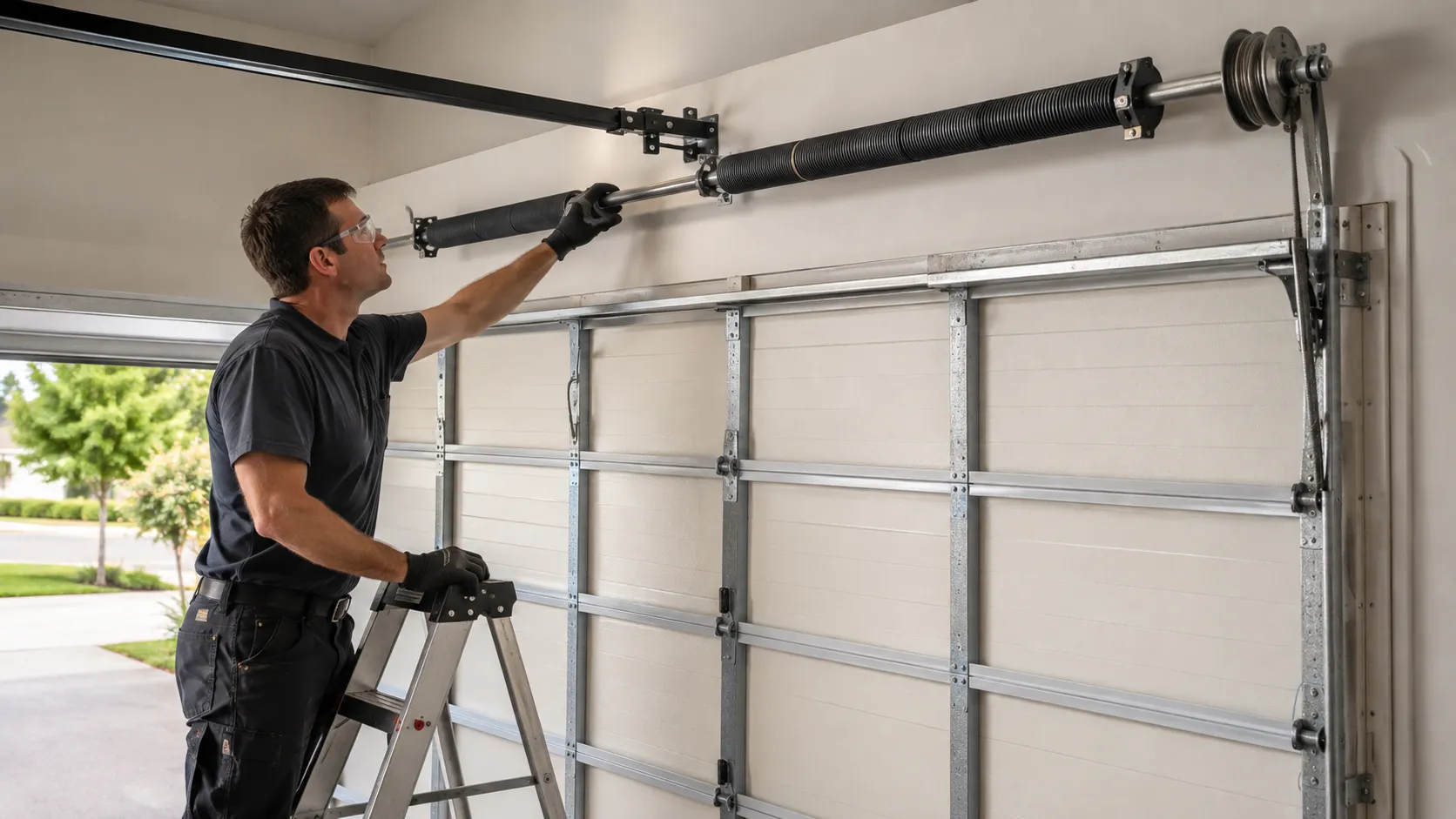
On a house from this era we're almost always dealing with a single torsion spring mounted above the door, or in some cases two smaller ones split across the shaft. First step is winding down whatever tension is still in the old spring safely - this is the step that hurts people who try it themselves, and it's not a place to save money. Once the spring's off, we check the cable drums, the center bearing plate, and the track for wear that piled up right alongside the spring failure. On a door this old, the drums and bearing are frequently as original as the spring, and if they're scored or seized we replace them in the same visit rather than send you a second bill later. We also check the winding cones for corrosion, since Michigan winters get into any exposed hardware over sixty-some years. The door itself - panels, hinges - we leave alone unless something's actually broken; a spring job isn't an excuse to sell you parts you don't need.
We don't have a fixed number to publish for Lincoln Park specifically, and we're not going to invent one. What we can tell you is that cost tracks with what we find once the spring's off - one spring versus two, whether the drums or bearing need replacing too, and the wire size the door actually needs, which depends on door weight, not on the town. Median household income here runs $57,183, noticeably below the roughly $71,783 median across the broader service area, and we mention that because it's part of why we quote the job in front of you before any work starts rather than after. No card on file, no surprise line item for a bearing you didn't ask about.
For a mid-1950s door we carry standard torsion springs in the wire sizes that fit the doors built in that period, along with matching cable, drums, and center bearing plates - the pieces that fail alongside a spring on hardware this old. What we don't stock on the truck are obsolete or oversized doors that some 1950s garages were built around; those sometimes need a special-order spring, and if that's the case we'll tell you on site rather than make you wait for a part we don't have. Michigan's cold-severe climate band means we also carry weatherstripping and bottom seals sized for the temperature swings this area sees, since a spring visit is a natural point to flag a seal that's cracked and letting cold air in.
The tell on a house this age is usually one of two things: the door drops fast in the last foot before it hits the ground, or it simply won't lift past knee height no matter how hard the opener strains. Both point at the torsion spring, and on original hardware from 1954 the failure often comes with a loud bang - the sound of decades-old steel finally letting go rather than a clean break. If you hear a snap and then find the door won't budge, don't force it with the opener. Running the motor against a broken spring is how you burn out a perfectly good opener trying to lift dead weight it was never built to handle alone.
We cover Lincoln Park from our Canton location, roughly a 16-mile drive, and we schedule the trip around what you tell us on the phone - door age, whether it's one spring or two, whether it's already stuck open or shut. See our Lincoln Park service area page for how the visit works, and if you're comparing this against our broader write-up for the Canton service area, that's here: garage door spring repair in Canton, MI.
It's common. Springs only get replaced when they break or someone upgrades the door, so a lot of Lincoln Park garages built around 1954 are still running the torsion hardware that went up with the house. It's not a guarantee, but we treat it as the likely case when we quote a job.
No. We're based in Canton and drive out to Lincoln Park, about 16 miles, for spring repair calls. We don't keep a branch or depot in town, so we plan the visit by phone first.
Torsion springs store a lot of tension, and on hardware that's decades old the steel eventually fatigues rather than wearing gradually. When it finally lets go, it releases that tension all at once, which is the bang you hear.
We'd advise against it. Winding down or up a torsion spring under tension is the step that causes serious injuries when people try it without the right bars and clamps. It's also easy to misjudge the wire size, which leaves the door imbalanced even after the swap.
Call now or request a free quote - same-day service on most repairs, upfront written pricing.